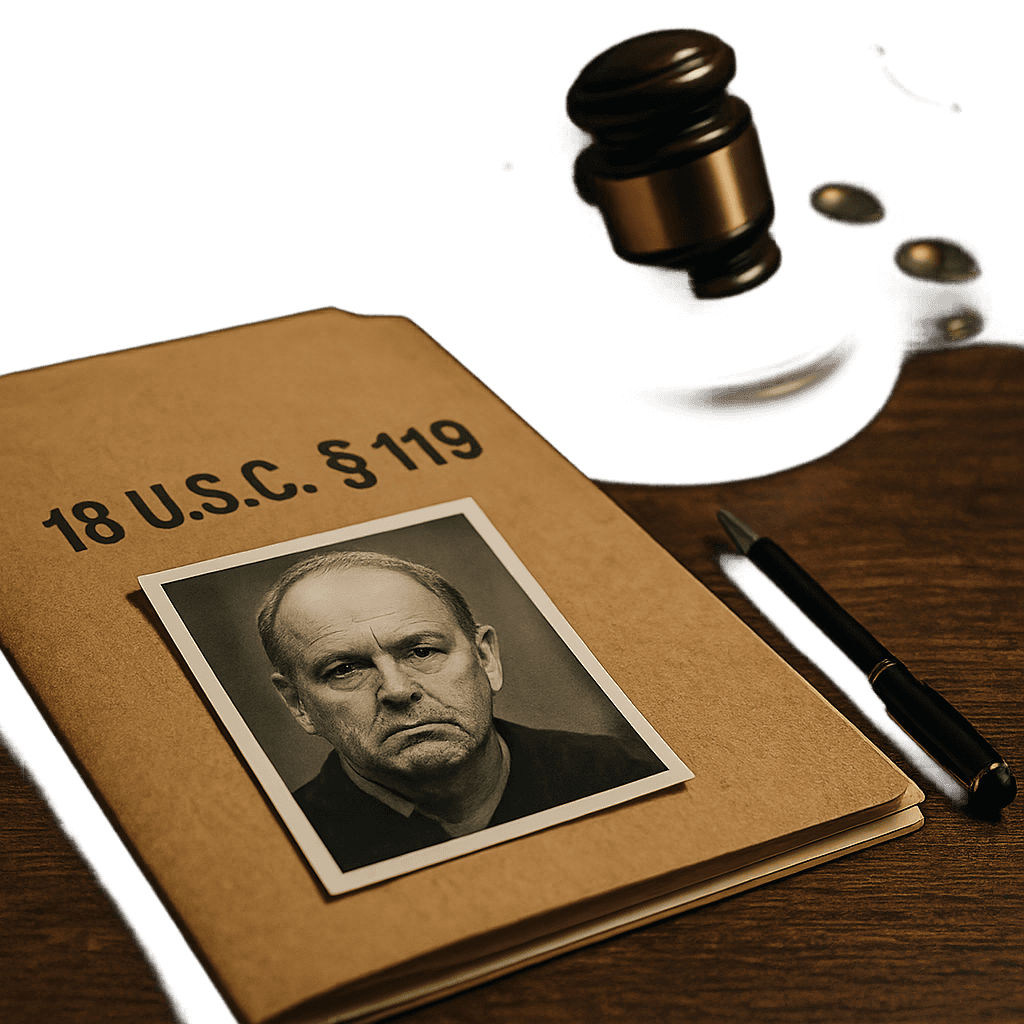
Kyle Andrew Edwards, 59, of Alexander, North Carolina, entered a guilty plea on May 6, 2026, in U.S. District Court for the Western District of North Carolina to a single count of violating 18 U.S.C. § 119. According to U.S. Attorney Russ Ferguson, Edwards admitted to posting a sitting Supreme Court justice's home address on social media with intent to threaten, intimidate, or incite a crime of violence. He faces up to five years in federal prison. Sentencing has not been scheduled. Edwards remains on bond.
The plea is small in raw numbers but large in legal signal. A statute that sat largely dormant for years after its 2008 enactment is now being used to charge online posters who publish federal officials' personal information paired with violent intent. For criminal defense practitioners, the Edwards case is a clean test of how § 119 will be litigated against ordinary social-media speakers in a polarized environment.
What § 119 Actually Criminalizes
The statute, formally titled Protection of individuals performing certain official duties, makes it a felony to knowingly publish "restricted personal information" about a covered person with either (a) the intent to threaten, intimidate, or incite a crime of violence, or (b) knowledge that another person will use the information to do so. The full text is available through Cornell's Legal Information Institute (18 U.S.C. § 119).
Six categories of data qualify as restricted personal information:
-
Social Security number
-
Home address
-
Home phone
-
Mobile phone
-
Personal email
-
Home fax
Covered persons are not limited to federal judges. The statute reaches officials enumerated in 18 U.S.C. § 1114, federal grand and petit jurors, witnesses and court officers, federal criminal informants and witnesses, and state or local officers whose information is exposed because they assisted a federal investigation.
The maximum penalty is five years per count. Prosecutors typically choose between § 119 and adjacent statutes such as 18 U.S.C. § 115 (threats against federal officials) or 18 U.S.C. § 875(c) (interstate threats). § 119 has two advantages for the government. It does not require proving a true threat directed at a specific official, and it captures the act of publication itself when paired with the requisite intent.
The Edwards Record
According to the U.S. Attorney's release as carried by WLOS and Fox Carolina, Edwards posted the home address of one sitting justice and, the same day, partial or historical address information for two additional justices. The justices have not been publicly named by prosecutors.
The posts included statements that justices should "think again" if they thought "their families are safe," and urged readers to "start dragging the SC out by their robes" and turn the justices "into charcoal." Those quotes appear in the U.S. Attorney's release as reproduced by Sinclair affiliates and The Record.
The conduct period reported by The Hill spans April through June 2025. Edwards pleaded to a single count, which is procedurally consistent with a negotiated plea that captures the most easily proven conduct and leaves sentencing exposure within a defined range.
How We Got Here: The Daniel Anderl Act
Section 119 entered a new era in December 2022 with the passage of the Daniel Anderl Judicial Security and Privacy Act, enacted as part of the National Defense Authorization Act and signed into law as Public Law 117-263. The statute (S. 2340) was named for the son of U.S. District Judge Esther Salas, who was killed in July 2020 by an attorney who used internet-sourced information to find the family's home, per the U.S. Courts account.
The Anderl Act bars federal agencies and certain private data brokers from publicly posting federal judges' personal information and creates removal rights for judges. § 119 supplies the criminal hook on the back end. Where Anderl suppresses the supply of judicial PII, § 119 punishes its publication when paired with violent intent.
The Edwards plea also lands inside a broader environment that includes the Roske matter at Justice Brett Kavanaugh's home, which drew a 97-month federal sentence, per CBS News.
The First Amendment Fight
Defense lawyers in § 119 cases run two main constitutional arguments: facial overbreadth and as-applied. Eugene Volokh's analysis at The Volokh Conspiracy notes that § 119, "properly interpreted, would likely fit within the First Amendment exceptions for threats, incitement, or solicitation." Volokh also writes that the broader question of barring publication of officials' addresses is "unsettled and difficult."
The doctrinal anchors are familiar. The Supreme Court's decision in Counterman v. Colorado requires recklessness as to the threatening character of a statement before it falls outside First Amendment protection. Brandenburg v. Ohio caps incitement liability at speech directed to producing and likely to produce imminent lawless action. Solicitation reaches speech that asks another person to commit a specific crime.
The awkward fact for any defendant: home addresses are often technically available through property records, voter rolls, and commercial data brokers. § 119 does not require that the address be secret. It requires that the publisher pair the disclosure with the statutory mens rea. That is why prosecutors emphasize the "robes" and "charcoal" language in the Edwards posts. The address is the actus reus. The surrounding text supplies the intent.
No published federal appellate decision has yet held § 119 unconstitutional as applied to ordinary online posters. District-court motions to dismiss have generally turned on intent and the public availability of the underlying information rather than facial overbreadth.
Is This a Wave or a Trickle?
The honest answer is that § 119 charges remain rare even as the surrounding ecosystem of threat prosecutions expands. Per CBS News, citing DOJ and U.S. Marshals data, federal prosecutors brought 126 cases in 2025 across all 94 districts charging threats against federal and top state officials. The breakdown:
-
12 cases targeting judges
-
41 involving Presidents Trump, Biden, or Obama
-
29 against federal law enforcement
-
21 against members of Congress
-
50 other officials
The U.S. Marshals Service recorded 564 threats against federal judges in the most recent fiscal year, up from 509 in fiscal year 2024, with 176 threats logged from October through January. Chief Justice Roberts has said judicial threats have tripled over the prior decade, per the same CBS reporting.
§ 119 dispositions specifically remain a small but growing line. The directly comparable prior conviction is William Kaetz of Paramus, New Jersey, who pleaded guilty in 2021 to posting a federal judge's home address on Facebook and Twitter on October 18, 2020. Kaetz received 16 months in federal prison plus three years of supervised release and a $5,000 fine, per the U.S. Attorney's Office for the Western District of Pennsylvania, the ABA Journal, and Newsweek. He had originally been charged with threatening a federal judge. § 119 was the plea count.
The Kaetz sentence is useful as a benchmark for what a § 119 plea can draw. It does not establish a guideline floor, and Edwards's exposure will turn on his offense level under USSG § 2A6.1, his criminal history, and acceptance of responsibility credit.
What Defense Lawyers Are Doing
Practitioners handling § 119 matters typically attack on four fronts:
-
Intent. The government must prove the defendant either intended to threaten, intimidate, or incite violence, or knew the information would be used to do so. Posts that criticize officials without explicit calls to violence may fall short. Motions to dismiss test whether the indictment alleges intent with sufficient particularity.
-
Public availability. Some defendants have argued that information already in property records is not the kind of restricted personal information the statute targets. Courts have generally not adopted this reading where the statutory text is clear, but the argument continues to surface.
-
Evidence suppression. Social-media account warrants, IP attribution, and the chain of custody for screenshots routinely draw suppression motions.
-
Sentencing mitigation. Mental health treatment records, absence of any overt act, and the gap between speech and any actual harm are standard mitigation themes in § 119 sentencings.
What's Coming Next
Congress is considering expanding § 119's logic. H.R. 5118, the Protecting Law Enforcement from Doxxing Act, would extend criminal liability to publishing law enforcement officers' personal information. The bill remains pending as of this writing and its status should be checked before relying on it in advice to clients.
State doxxing statutes, often broader than § 119 in scope and narrower in penalty, continue to proliferate. Defense lawyers handling online-speech matters now routinely confront overlapping state and federal exposure on the same set of posts.
The Practical Takeaway
The conduct that realistically draws a § 119 charge has three elements: a covered person (most often a federal judge or other federal official), publication of at least one of the six restricted PII categories (home address is by far the most common), and either intent to threaten or incite violence, or knowledge that someone else will use the information for that purpose.
Political speech that criticizes officials, even harshly, without publishing the protected data categories remains outside the statute. The narrow zone where § 119 bites is the combination of restricted PII plus violent context. That zone is where Edwards now sits, and where future defendants will continue to be charged as DOJ and the Marshals Service treat the post-Anderl environment as a sustained enforcement priority.
Related reading
Sources
-
Eugene Volokh, "Man Pleads Guilty to 'Doxxing' Home Address of United States Supreme Court Justice," Reason / The Volokh Conspiracy, May 11, 2026.
-
"North Carolina man pleads guilty to doxxing Supreme Court justice," The Hill, May 2026.
-
"Guilty plea: Western NC man accused of doxxing U.S. Supreme Court Justice," Fox Carolina, May 6, 2026.
-
"North Carolina man pleads guilty to doxxing Supreme Court justices," The Record (Recorded Future News).
-
18 U.S.C. § 119, Cornell Legal Information Institute.
-
U.S. Courts: "Congress Passes the Daniel Anderl Judicial Security and Privacy Act."
-
S. 2340, Daniel Anderl Judicial Security and Privacy Act of 2021.
Note: This article contains AI-assisted content and has been reviewed by our editorial team.
IMPORTANT NOTICE: GavelDaily.com is an advertising and information service, not a law firm. Submitting this form does not create an attorney-client relationship. The information you provide will be shared with licensed criminal defense attorneys in your area who may contact you about your inquiry. All submissions are treated as confidential by our service, but attorney-client privilege does not attach until you formally retain an attorney. Any attorney you connect with through this service is independently responsible for their legal advice and representation. Free consultations are subject to individual attorney availability. If you are facing an immediate legal emergency, contact your local public defender's office or call 911.