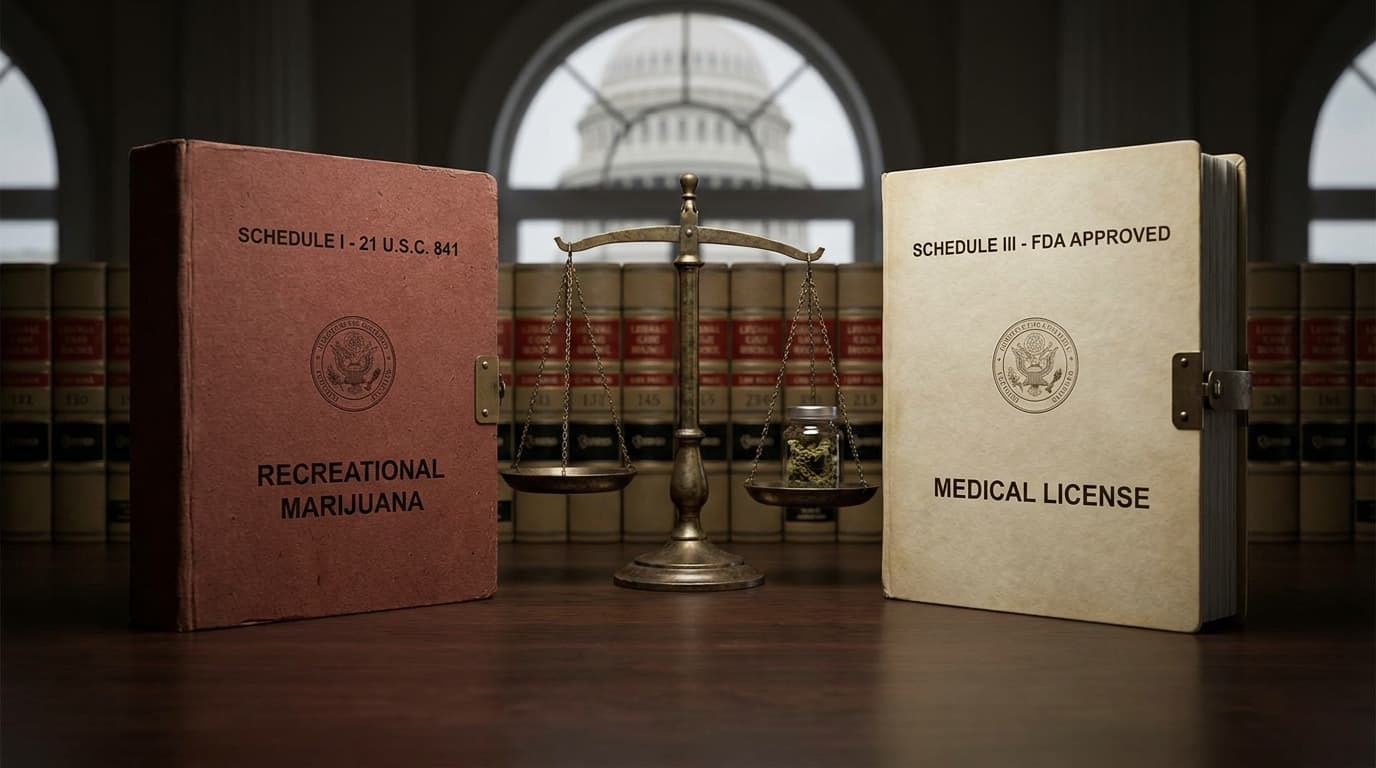
Picture two buildings on the same street. In one, a cultivator holds a state medical marijuana license and grows flower under it. In the other, a licensed adult-use retailer sells flower from the same genetics, same potency, same lab. As of April 28, 2026, the first building's inventory is a Schedule III controlled substance under federal law. The second building's inventory is Schedule I, in the same federal category as heroin.
Nothing about the chemistry changed. The federal schedule now turns on the paperwork attached to the product.
That distinction has been reported as a softening of federal marijuana law. For anyone actually facing a federal charge, it is closer to the opposite: a narrow regulatory carve-out that leaves the penalty structure in 21 U.S.C. § 841 almost entirely intact, and that in one reading could leave a small-quantity defendant exposed to more time, not less.
What actually happened, precisely
On April 23, 2026, Acting Attorney General Todd Blanche signed a final order rescheduling two categories of marijuana. The order was published in the Federal Register on April 28, 2026, at 91 FR 22714, and took effect the same day.
The Schedule III category the order creates is defined by two conditions. Marijuana, marijuana extracts, delta-9-THC, and related compounds derived from the plant (excluding mature stalks and seeds) move to Schedule III when they are either:
-
contained in an FDA-approved drug product, or
-
held under a qualifying state-issued medical marijuana license.
Everything else stays where it was. The rule also imposes import and export permit requirements on the newly rescheduled substances and creates an expedited DEA registration process for state medical licensees.
Two features of how this was done matter for the litigation now pending. First, the order was issued under 21 U.S.C. § 811(d), the provision directing the Attorney General to schedule substances as necessary to carry out United States obligations under the 1961 U.N. Single Convention on Narcotic Drugs. That treaty-implementation route is what allowed the order to take effect immediately without finishing the notice-and-comment rulemaking that had been pending since the May 2024 proposed rule.
Second, the rescheduling order is a separate document from the DEA hearing notice published the same day at 91 FR 22777. Coverage has repeatedly conflated the two. One is a final rule that is already law. The other schedules an administrative hearing on the broader question of moving marijuana generally.
Who is on the wrong side of the line
The order says this in its own words, as quoted in the Drug Policy Alliance explainer:
"any form of marijuana other than that in a FDA-approved drug product or marijuana subject to a state medical marijuana license remains a Schedule I controlled substance, and those who handle such materials remain subject to the regulatory controls, and administrative, civil and criminal sanctions, applicable to Schedule I controlled substances set forth in the CSA and DEA regulations."
Read that against who typically ends up in federal court on a marijuana charge. Unlicensed growers. People moving product across state lines. Workers in the adult-use market. Operators whose state license lapsed, was suspended, or never covered the specific conduct at issue. Every one of those categories sits outside the Schedule III box by definition.
This is the structural point that most coverage misses. A federal marijuana defendant is, close to by construction, someone whose conduct lacked a qualifying state medical license, because that is precisely the conduct the order left in Schedule I. The two-tier structure does very little charging work in real federal prosecutions. It is a regulatory and tax line drawn around a compliant medical market, not a defense available to people the government charges.
Does Schedule III lower anyone's statutory exposure?
Here is where the analysis gets counterintuitive, and where a defendant should be careful about assuming good news.
The federal trafficking penalties in § 841(b)(1) are not written as a single schedule-driven scale. They are a patchwork, and marijuana appears in several of them by name and by quantity rather than by schedule. The relevant text:
| Subparagraph | Trigger | Penalty | | --- | --- | --- | | § 841(b)(1)(A)(vii) | 1,000 kg or more of marihuana, or 1,000 or more plants | 10 years to life | | § 841(b)(1)(B)(vii) | 100 kg or more of marihuana, or 100 or more plants | 5 to 40 years | | § 841(b)(1)(C) | a controlled substance in schedule I or II | up to 20 years | | § 841(b)(1)(D) | less than 50 kilograms of marihuana (except 50 or more plants, 10 kg hashish, 1 kg hash oil) | up to 5 years | | § 841(b)(1)(E)(i) | any controlled substance in schedule III | up to 10 years, 15 if death or serious bodily injury results |
Work through it. The two mandatory-minimum tiers, (A)(vii) and (B)(vii), identify marihuana by weight and plant count. They contain no schedule cross-reference at all. A schedule change cannot touch them. A person charged with 1,000 kilograms still faces 10 years to life whether marijuana sits in Schedule I, Schedule III, or anywhere else, unless Congress amends the statute.
Below 50 kilograms, subparagraph (D) already caps exposure at five years. The generic Schedule III penalty in (E)(i) caps at ten. So for the smallest cases, Schedule III status offers no benefit, and if a court were to apply (E) instead of (D), the defendant would be worse off by five years.
Whether (D) or (E) governs sub-50-kilogram marijuana that falls inside the new Schedule III category is an open question. It has not been litigated. The argument for (D) rests on the canon that a specific provision governs over a general one, and (D) names marihuana explicitly while (E) sweeps in every Schedule III substance. That is a strong argument, but it is an argument, not a holding. Anyone told otherwise is being sold certainty that does not exist yet.
There is exactly one band where a schedule change plausibly cuts statutory exposure: 50 kilograms up to 100 kilograms, and 50 to 99 plants. That quantity falls outside (D) by its own exception clause and below (B)(vii)'s threshold, so it currently routes through (C), which carries a 20-year maximum keyed to Schedule I or II status. If marijuana were not in Schedule I or II, that conduct would fall to (E)(i)'s 10-year maximum. That is the narrow window. It is not nothing, but it is a fraction of the federal marijuana docket.
The guidelines do not move either
Statutory maximums are only half the sentencing picture. The other half is the advisory guideline range, and it is built the same way.
The Drug Quantity Table in USSG §2D1.1 lists marihuana by weight and converts it into converted drug weight. The offense level is driven by quantity, not by which schedule the substance occupies. On that structure, an offense level does not shift when a substance is rescheduled. Defense counsel should confirm the current Guidelines Manual text for the specific quantity at issue rather than relying on a general description.
The thing to watch instead is the amendment cycle. The Sentencing Commission voted on April 16, 2026 to promulgate seven amendments taking effect November 1, 2026, one of which addresses drug offenses. Whether that amendment reaches marijuana at all is a question to check against the promulgated text before assuming either way.
Retroactivity: no one gets out
This deserves to be stated flatly, because families of incarcerated people have been reading rescheduling headlines as release news. The Drug Policy Alliance explainer puts it directly: rescheduling "will not release anyone incarcerated for marijuana, nor will it restore rights to those with previous marijuana convictions."
The mechanics behind that are worth understanding, because they explain why the usual post-conviction tools do not reach this.
A sentence reduction under 18 U.S.C. § 3582(c)(2) requires that the defendant's guideline range was subsequently lowered by a Sentencing Commission amendment that the Commission designated retroactive under USSG §1B1.10. An administrative schedule change is not a guideline amendment and does not appear on that list. Nothing has been made retroactive here.
Separately, the general savings statute at 1 U.S.C. § 109 preserves penalties incurred under prior law when that law is repealed or altered, absent an express contrary provision. And the schedule change is not a change to the statute of conviction: the defendant was convicted under § 841 or § 844, and those statutes read today exactly as they did before April 28.
Counsel will still raise these arguments, and there is no reason not to preserve them. Compassionate release motions under § 3582(c)(1)(A) invoking changed federal policy as an extraordinary and compelling circumstance are the likeliest vehicle. But a client should be told at the outset that this is an uphill motion built on a policy-shift theory, not a mechanical recalculation, and that the current legal landscape offers no automatic relief.
The paperwork tier carries its own criminal exposure
Schedule III is a regulatory regime, not an amnesty. That is easy to lose sight of, because most public discussion of scheduling focuses on penalties rather than obligations.
Entities handling Schedule III marijuana must hold a valid DEA registration and comply with DEA rules covering fees, security, disposal, prescribing, labeling, inventory, and recordkeeping. Distributing a controlled substance without registration remains a federal crime under the Controlled Substances Act regardless of what schedule the substance occupies. A state medical license that moved a product into Schedule III does not substitute for the federal registration that Schedule III status then requires.
The expedited process the rule creates treats existing state credentials as evidence, and requires approval unless a registration would conflict with the public interest or Single Convention requirements. That is a meaningful accommodation. It is not a rubber stamp. According to the Frantz Ward summary of developments two months in, DEA has begun conducting onsite inspections of medical marijuana registration applicants, requesting ownership documentation, compliance history, inventory system records, and security documentation.
For an operator, the practical result is that entering the Schedule III tier means inviting a federal regulator through the door. Some will find the tax benefit worth it. IRC § 280E, which disallows ordinary business deductions, applies only to Schedule I and II substances, so state-licensed medical operators inside the new category get 280E relief. Adult-use operators do not.
One more unresolved thread: the order does not settle the status of marijuana sold as food, as a dietary supplement, or as an unapproved drug under the Food, Drug, and Cosmetic Act. That is a category FDA has historically declined to police, and a Schedule III designation arguably pulls it toward a stricter approval framework rather than a looser one.
What the broader rescheduling proceeding would and would not do
The separate DEA proceeding on rescheduling marijuana generally is further along than most coverage reflects. The expedited hearing opened June 29, 2026 and closed with closing arguments on July 15, 2026, after 17 hearing days, before Chief Administrative Law Judge Derek Julius.
As of today, nothing is sitting with a decisionmaker. Post-hearing briefs, capped at 50 pages, are due August 17, 2026. After briefing, Judge Julius issues a recommended decision, and the DEA Administrator makes the final call. Julius announced no timeline for either step. Observers expect a recommendation late in 2026, which means a final agency decision could come well after that.
Even a full move of marijuana to Schedule III would leave the § 841 quantity tiers standing, would leave simple possession under 21 U.S.C. § 844 on the books, would leave the DEA registration requirement in place, and would leave every collateral consequence untouched. Rescheduling is not legalization, and Schedule III is not a shield.
The litigation overhang
Three petitions for review are consolidated in the U.S. Court of Appeals for the D.C. Circuit:
-
Smart Approaches to Marijuana, Inc. v. DOJ, filed May 4, 2026.
-
A joint petition by Nebraska, Indiana, and Louisiana, filed May 22, 2026, alleging improper promulgation under the Administrative Procedure Act, inconsistency with the CSA and drug treaties, and arbitrary and capricious action. Louisiana withdrew on May 29, 2026.
-
A coalition petition filed May 28, 2026 by a substance-abuse treatment provider, two physicians, an advocacy organization, and MMJ International Holdings, raising APA, CSA, and constitutional claims plus a theory that the order confers an unlawful competitive advantage on state licensees over federally compliant drug developers.
The common target is the § 811(d) treaty route, which is what let the order skip notice and comment. If the D.C. Circuit vacates, the medical tier goes back into Schedule I. Anyone building a compliance posture, a business plan, or a legal argument on the April order should treat it as provisional.
The numbers behind the noise
Federal marijuana enforcement was already contracting well before any of this. The Sentencing Commission's Quick Facts on marijuana trafficking for fiscal year 2025, published in May 2026, shows the trajectory:
-
995 marijuana trafficking cases in FY2021, then 806, 561, 471, and 383 in FY2025. That is a decline of roughly 61% in four years.
-
Of 66,662 total federal cases reported in FY2025, 16,234 involved drugs. Marijuana accounted for about 2% of drug cases.
-
Average sentence: 44 months. 85% of those sentenced received prison.
-
34% were convicted of an offense carrying a mandatory minimum, and 58% of that group were relieved of it. The safety valve applied in 36% of cases.
-
Median base offense level was 24, corresponding to 100 to 400 kilograms of marijuana.
-
64% fell in Criminal History Category I. 80% were U.S. citizens. A weapon enhancement applied in 36% of cases.
-
Cases cluster in border districts: Western District of Texas (43), Southern District of Texas (38), Eastern District of Virginia (27), Eastern District of California (19), Western District of Louisiana (18), Western District of Oklahoma (18).
Two things stand out for a defense practitioner. The median case involves a quantity that sits above the sub-50-kilogram tier, which means most defendants are not in the band where any of this scheduling debate would help. And the weapon enhancement rate of 36% is a reminder that in a real prosecution, the firearm allegation often drives more sentencing exposure than the drug schedule ever will.
What this means for someone charged right now
Three things to take from this if you are facing a federal marijuana charge or advising someone who is.
Charged conduct is evaluated as of the time of the offense. Conduct that occurred before April 28, 2026 is measured against the law in effect then. And because the schedule change did not alter § 841's text, it does not retroactively rewrite anyone's exposure regardless.
A state medical license is a factual predicate to develop, not a defense to assume. If a client held a qualifying license covering the conduct at issue, that is worth documenting carefully and early: the license type, its scope, its status on the relevant dates, and whether the specific product and activity fell within it. But the government's charging theory in most federal cases is built on the absence of exactly that license, and the tier the order created is drawn narrowly enough that near-compliance does not reach it.
The collateral consequences are untouched. Firearm prohibitions for unlawful users of controlled substances still apply. Immigration exposure is unchanged, and the Drug Policy Alliance explainer notes that marijuana activity "could still result in family separation and deportation" for noncitizens. Bars to employment, housing, and public benefits including SNAP all persist. If those consequences are what a client is most worried about, the April order changed nothing for them.
The mechanism that would reach past convictions, restore rights, and clear records is not rescheduling by an agency. It is descheduling by Congress. Until that happens, the federal line between Schedule I and Schedule III marijuana is a line about licenses and taxes, drawn around a market most federal defendants were never standing in.
Related reading
-
[Colorado Expands Its Domestic Violence Definition on August 12: Monitoring, Isolation, and Financial Control Now Count in Custody Cases](/news/colorado-hb26-1309-coercive-control-custody-domestic-violence)
-
[The Fine Print That Waives Your Appeal Can Now Be Torn Up: In Hunter v. United States the Supreme Court Says a Plea Deal Can't Lock In a 'Miscarriage of Justice'](/news/hunter-v-united-states-appeal-waiver-miscarriage-of-justice)
Sources
-
Schedules of Controlled Substances: Rescheduling of Food and Drug Administration Approved Products Containing Marijuana From Schedule I to Schedule III; Corresponding Change to Permit Requirements, 91 FR 22714 (Apr. 28, 2026)
-
Schedules of Controlled Substances: Rescheduling of Marijuana (hearing notice), 91 FR 22777 (Apr. 28, 2026)
-
21 U.S.C. § 841, Legal Information Institute, Cornell Law School
-
21 U.S.C. § 841, Office of the Law Revision Counsel, U.S. Code
-
DEA Downschedules State Medical Marijuana to Schedule III; Expedited Hearing Set to Consider Broader Rescheduling, Gibson Dunn
-
Two Months Out: Continuing Developments After Challenges to Rescheduling Order are Ongoing, Frantz Ward LLP
-
Federal Marijuana Rescheduling Hearing Wraps Up, With DEA Judge Laying Out Next Steps, Marijuana Moment
-
Quick Facts: Marijuana Trafficking Offenses, Fiscal Year 2025, U.S. Sentencing Commission
-
Marijuana topic page, U.S. Sentencing Commission
-
Federal Marijuana Rescheduling Explainer (May 2026), Drug Policy Alliance
-
DOJ Reschedules State-Legal Medical Cannabis to Schedule III: Questions and Answers, Marijuana Policy Project
Note: This article contains AI-assisted content and has been reviewed by our editorial team.
IMPORTANT NOTICE: GavelDaily.com is an advertising and information service, not a law firm. Submitting this form does not create an attorney-client relationship. The information you provide will be shared with licensed criminal defense attorneys in your area who may contact you about your inquiry. All submissions are treated as confidential by our service, but attorney-client privilege does not attach until you formally retain an attorney. Any attorney you connect with through this service is independently responsible for their legal advice and representation. Free consultations are subject to individual attorney availability. If you are facing an immediate legal emergency, contact your local public defender's office or call 911.