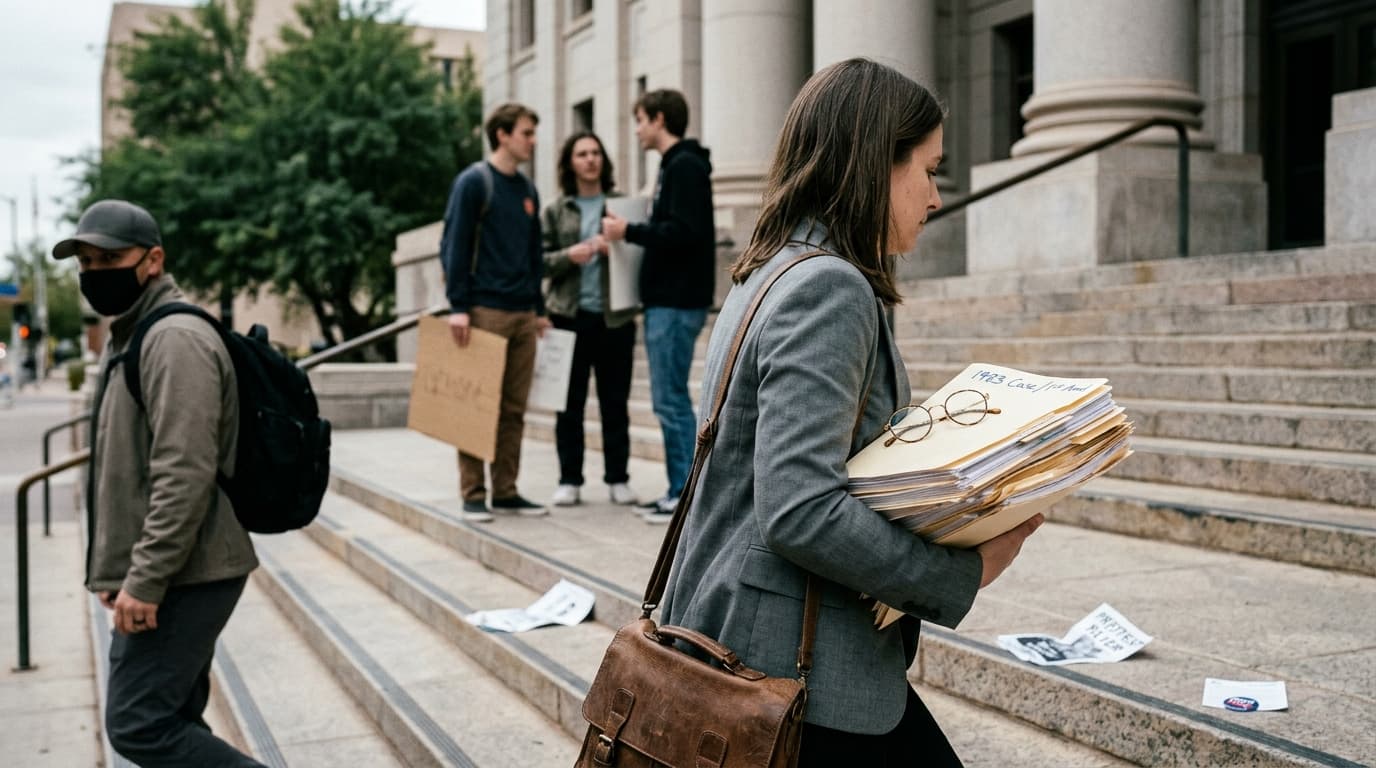
A federal judge in Phoenix has ruled that the off-duty Phoenix police sergeant who showed up masked, armed, and in a Trump 2024 shirt at a high school anti-ICE walkout in Chandler probably had his First Amendment rights violated when the city fired him. The order denied the sergeant's request for emergency reinstatement, but the same logic the court used to defend his counterprotest cuts directly in favor of the student protesters he was trying to provoke, and in favor of any defendant now facing Arizona disorderly conduct or assault charges out of a counterprotest setting.
The case is Mullen v. Giordano. The opinion is 15 pages. It is preliminary, civil, and not binding on a state criminal court. But defense counsel building motions in cases arising from the spring 2026 ICE protests should read it, because the doctrinal moves the court made are exactly the moves defenders need.
What the court actually decided
On May 21, 2026, U.S. District Judge Susan R. Brnovich denied a temporary restraining order and preliminary injunction that would have ordered the City of Phoenix to reinstate Sgt. Dusten Mullen pending trial. Mullen and the Arizona Conference of Police and Sheriffs lost on the emergency relief because the court found Mullen had not shown irreparable harm and that the equities did not favor immediate reinstatement.
That part is a loss. The next part is not. Brnovich wrote that 'the merits of Plaintiffs' case are strong,' and the opinion's reasoning on the First Amendment retaliation theory reads as a roadmap the case will follow toward summary judgment and trial. According to Phoenix New Times, which obtained and reported on the order, the court concluded that 'public criticism seems to be the but-for cause of Sgt. Mullen's firing' and that the internal investigation was 'rushed and conclusory.'
The distinction matters. An injunction loss is a procedural disposition about timing and balance of harms. A merits finding that the plaintiff's First Amendment claim is strong is a substantive signal about what the court thinks happened.
The factual record the court credited
The underlying incident occurred on January 30, 2026, at Hamilton High School in Chandler, where students walked out to protest federal immigration enforcement. Mullen, off duty, appeared at the counterprotest masked, openly armed under Arizona law, and wearing a Trump 2024 shirt. He recorded video. Chandler police, who were on scene, asked him to leave. One student was arrested for throwing water on him. Prosecutors later declined to file charges against that student.
The city's case against Mullen rested in part on a statement he made to Chandler officers that he hoped students would assault him so they could be arrested. The City of Phoenix terminated him on May 14, 2026 after a Loudermill hearing before Chief Matt Giordano. Reporting from Phoenix New Times and KTAR documents the firing and the chief's stated rationale of judgment and professionalism failures.
Brnovich reviewed body-camera footage and declined to credit the city's 'provocation' framing. KJZZ reports that the court read the video as showing Mullen asking students whether they wanted to talk and expressing frustration that officers were not intervening against students he viewed as aggressive. The court treated the 'assault me' comment as frustration rather than as a confession of intent to provoke a crime.
The doctrinal move that matters for defenders
The most important paragraph in the order, for criminal defense purposes, is the one where the court treats an off-duty officer as a private citizen speaking on a matter of public concern. Brnovich wrote that police 'have First Amendment rights when they're off duty.' The court did not run the usual Pickering or Garcetti analysis that constrains public-employee speech inside the scope of official duties, because the court found Mullen was not speaking inside that scope. He was at a protest on his own time, in his own clothes, expressing his own views.
That framing is portable. When the State charges a counterprotester with assault on a peace officer under A.R.S. section 13-1203 or with disorderly conduct under A.R.S. section 13-2904, the charging theory often leans on the identity of the alleged victim as a police officer or on the protected status of the State's preferred speaker. Mullen stands for the proposition, in this district, that an off-duty officer at a protest is not a peace officer doing peace-officer work. He is a citizen. If the alleged victim of an assault was off duty and engaging the protest as a private speaker, the special protections that elevate the offense level fall away by the same logic the federal court just applied in reverse.
Recording police is speech
The order also restates, in plain language, that 'recording of police activity alone is sufficient to trigger First Amendment protections.' That is consistent with circuit precedent but worth flagging because Arizona disorderly conduct prosecutions sometimes sweep in protesters who were filming arrests. A defense motion that quotes this line from a sitting federal judge in the District of Arizona, in a case involving the exact protest cycle the prosecution is responding to, has rhetorical weight beyond its formal persuasive value.
Viewpoint discrimination and the 'but-for' finding
Brnovich found that Phoenix Councilwoman Anna Hernandez's public demand for action drove the investigation and that the investigation that followed was 'rushed and conclusory.' The court concluded public criticism was the but-for cause of the firing. That is a viewpoint-discrimination finding in retaliation clothing.
The analogy for criminal defense is selective prosecution. If a defendant can show that charging decisions track the political identity of the speaker, that prosecutors moved faster or differently against counterprotesters of one ideological flavor than the other, or that public pressure from named officials drove the filing decision, the Mullen reasoning offers a federal-court template for how to write that argument. The bar for a selective-prosecution claim in state court is high, but the analytical pattern is the same: the State's action correlated with viewpoint, and the State has to articulate a non-speech reason.
The speech versus conduct line
Phoenix argued that Mullen's presence at the protest, masked and armed, was conduct rather than speech, and that the conduct was provocative. The court rejected that on the video record. The opinion does not treat provocative presence as unprotected.
Disorderly conduct prosecutions under A.R.S. section 13-2904 routinely turn on whether the State can characterize shouted slogans, masks, or aggressive posture as unprotected conduct rather than as protected speech. Mullen, on its face, requires the State to actually show non-speech conduct before the protection drops out. The court demanded specifics from the city and found the video did not support the city's characterization. Defenders can demand the same specificity from prosecutors at the motion-to-dismiss stage.
A practical motion checklist
For lawyers defending clients charged under A.R.S. section 13-2904 or section 13-1203 arising from counterprotest contact with off-duty officers or with police-adjacent counterprotesters, the practical takeaways from Mullen break down into five moves:
-
Characterize the underlying conduct as speech. Identify the slogan, the sign, the mask, the recording, or the gesture, and place it inside the First Amendment.
-
Force the State to articulate the non-speech conduct that supports the charge. If the State cannot separate the conduct from the speech, Mullen supplies persuasive authority that the speech component cannot be punished as conduct.
-
Press viewpoint neutrality. If the same conduct from a differently aligned protester would not have produced a charge, document it.
-
Raise the recording-as-speech protection if any element of the charge touches the defendant's act of filming officers or others on scene.
-
If an off-duty officer is the complaining witness or the alleged victim, cite Mullen for the private-citizen framing. An off-duty officer at a protest is a private citizen, not a peace officer in the constitutional sense, by the federal court's own reasoning in this district.
What the prosecution will say back
Mullen is a preliminary ruling on a TRO and preliminary injunction motion. It is not a final judgment. It is a civil employment-retaliation case under 42 U.S.C. section 1983, not a criminal ruling. It does not bind a state court. The plaintiff lost the immediate relief he was seeking. Prosecutors will hit every one of those points, and they will be right on every one.
That is why the order is persuasive authority, not controlling authority. The job is to put it in front of a judge who is being asked to credit a charging theory that treats protected speech as unprotected conduct, and to use it as a federal court's recent, well-documented refusal to do the same.
Where this goes next
The civil case continues toward discovery and summary judgment. The named defendants are Chief Matt Giordano, Councilwoman Anna Hernandez, and the City of Phoenix. The operative complaint, available through Courthouse News, sets out the First and Fourteenth Amendment theories the court has now evaluated and found strong. Background on the chief's framing of the firing as a department-wide message is in KOLD's coverage, and earlier defense framing from Mullen's attorney is in AZFamily's April 17 report.
Meanwhile, watch Arizona state-court dockets for disorderly conduct and assault charges arising from spring 2026 ICE protests. The first defense briefs citing Mullen are coming.
Bottom line
If you are a defendant facing A.R.S. section 13-2904 or section 13-1203 charges out of a counterprotest, or if you are counsel building a motion to dismiss in that posture, the work is straightforward. Pull the 15-page order. Lift the private-citizen paragraph. Lift the recording-as-speech paragraph. Lift the but-for-causation finding. Put them in the motion. The State will have to respond, on the record, to a federal judge's reasoning that the same speech they are now prosecuting was protected when the speaker happened to be on the other side.
Related reading
Sources
-
Fired Phoenix cop's First Amendment claims 'are strong,' judge says (Phoenix New Times)
-
Judge won't reinstate Phoenix police sergeant fired over ICE protest as case continues (KJZZ)
-
Phoenix fires off-duty cop who tried to bait student protesters (Phoenix New Times)
-
Phoenix police sergeant fired following off-duty confrontation at high school ICE protest (KTAR)
-
Phoenix PD chief sends message with sergeant's firing over anti-ICE rally (KOLD)
-
Attorney disputes claims against Phoenix sergeant in Chandler protest case (AZFamily)
Note: This article contains AI-assisted content and has been reviewed by our editorial team.
IMPORTANT NOTICE: GavelDaily.com is an advertising and information service, not a law firm. Submitting this form does not create an attorney-client relationship. The information you provide will be shared with licensed criminal defense attorneys in your area who may contact you about your inquiry. All submissions are treated as confidential by our service, but attorney-client privilege does not attach until you formally retain an attorney. Any attorney you connect with through this service is independently responsible for their legal advice and representation. Free consultations are subject to individual attorney availability. If you are facing an immediate legal emergency, contact your local public defender's office or call 911.