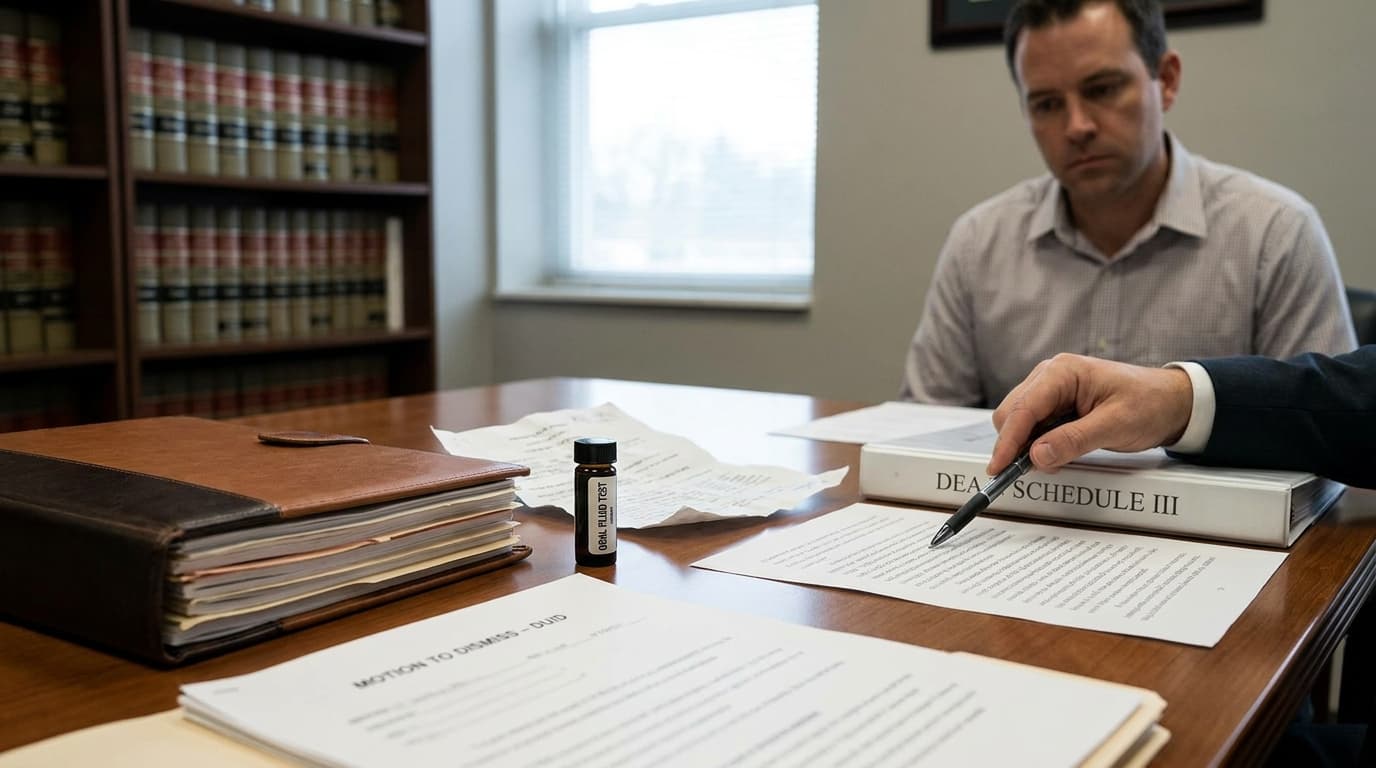
The legal scaffolding holding up cannabis DUI prosecutions in the United States was built on the assumption that marijuana was a Schedule I substance with no accepted medical use. That assumption changed on April 23, 2026, when the Drug Enforcement Administration issued a final order rescheduling FDA-approved marijuana drug products and state-licensed medical marijuana from Schedule I to Schedule III. A broader rescheduling hearing is set to begin June 29, 2026. The narrow rescheduling has already opened a defense theory that is producing motions in limine, suppression rulings, and pretrial dismissals across per se THC states.
The core problem for prosecutors is structural. Per se nanogram laws were drafted as the cannabis analog of the 0.08 BAC alcohol rule. They convert the mere presence of active THC above a fixed threshold into the offense itself. That structure works for alcohol because blood alcohol concentration tracks impairment closely. It does not work for cannabis, and the science saying so has been on the record at the federal level for nearly a decade. The Schedule III move now adds a second layer: in states that recognize a valid-prescription affirmative defense, a Schedule III drug is supposed to be defensible the same way a prescribed opioid or benzodiazepine is.
What the April 2026 DEA Final Order Actually Did
The final order is narrower than headlines suggested. Only FDA-approved marijuana drug products and state-licensed medical marijuana move to Schedule III. Recreational and non-medical cannabis remains Schedule I. The Foley & Lardner analysis emphasizes that the agency carved out the most legally and medically defensible category and left the broader question for the June 29 administrative hearing.
The Congressional Research Service primer on rescheduling walks through the downstream criminal-law consequences. The most relevant for DUI-D practice is that Schedule III drugs are prescribable, and most state DUI statutes that permit a valid-prescription defense were drafted on the assumption that no marijuana product would ever qualify. That assumption is no longer true for state-licensed medical patients in jurisdictions whose products fall inside the FDA-approved or state-licensed buckets covered by the order.
The New Defense Theory in One Sentence
Per se THC limits now operate as a per se DUI rule for a prescribable Schedule III drug, which state DUI codes generally forbid for other prescription medications. Defense counsel are filing motions arguing that a 2 ng/mL or 5 ng/mL whole-blood THC threshold cannot survive equal-protection and due-process review when the same statute would not criminalize the mere presence of prescribed alprazolam or oxycodone at a sub-impairment concentration.
The argument is jurisdiction-sensitive. It depends on whether the state has a per se limit, whether it recognizes a valid-prescription affirmative defense, and whether the client is a state-licensed medical patient using a product that the DEA order actually covers.
The Per Se Target List
Per se THC limits exist in only a handful of states. The Marijuana Policy Project's summary and the NHTSA Countermeasures That Work overview identify the live targets:
-
Illinois: 5 ng/mL whole blood active THC under the state's per se statute.
-
Washington: 5 ng/mL under RCW 46.61.502.
-
Ohio: 2 ng/mL active THC, the lowest fixed per se threshold in the country.
-
Montana: 5 ng/mL.
-
Nevada: Repealed its strict per se limit for first and second DUIs in 2021. The 2 ng/mL active THC threshold still applies on a third offense or in crashes causing death or substantial bodily harm.
Colorado does not use a strict per se rule. The Colorado Department of Transportation describes the state's permissible-inference framework: at 5 ng/mL active THC, jurors may infer impairment but are not required to. That distinction matters at trial, because a permissible inference can be argued against on the evidence in a way that a strict per se cannot.
Twelve states use zero-tolerance laws that criminalize any detectable THC or its metabolites. Those statutes are the most vulnerable to the post-rescheduling argument, because they can convict a state-licensed medical patient who has not consumed cannabis for days.
The Affirmative Defense States
The NHTSA state-by-state DUID catalog identifies the jurisdictions that recognize a valid-prescription affirmative defense to driving under the influence of drugs: Arizona, Indiana, Iowa, Minnesota, North Carolina, and Wisconsin. Roughly twenty states statutorily bar 'legal entitlement to use' as a defense, foreclosing the argument at the threshold.
Wisconsin illustrates the tension the Schedule III move creates. The state recognizes a valid-prescription defense but, as NORML's drugged-driving summary notes, the statute specifies that a physician's marijuana recommendation is not a prescription. Defense counsel are now arguing that an FDA-approved Schedule III marijuana drug product is a prescription in the ordinary statutory sense, and that the recommendation carveout no longer fits products inside the DEA order's scope.
What the Science Says About THC and Impairment
The federal government's own position undermines per se laws. NHTSA's 2017 Report to Congress on Marijuana-Impaired Driving states that blood THC concentrations do not correlate well with impairment and that toxicologists cannot reliably testify that a specific THC concentration equates to impairment. NHTSA has not retracted that conclusion in subsequent guidance.
The pharmacokinetics matter because they are counterintuitive. Peer-reviewed work synthesized by Journalist's Resource shows that active Delta-9 THC in blood typically falls below 1 to 2 ng/mL within a few hours of smoked use, even while psychoactive effects can persist. Peak impairment frequently arrives after blood THC has already declined. A driver can be at their most impaired with a blood draw that would not trigger a per se threshold, and a frequent user can sit comfortably above the threshold with no recent use and no active impairment.
A 2025 semi-mechanistic pharmacometrics model published in PMC demonstrates that per se thresholds misclassify both impaired and non-impaired drivers depending on route of administration. Oral consumption produces a fundamentally different concentration curve from smoked or vaporized use, and the same nanogram value carries different impairment meaning at different points on each curve. A separate body of research summarized by Marijuana Moment concludes there is no linear relationship between blood THC and driving performance.
Carboxy-THC: Week-Old Metabolites in a Same-Day Prosecution
11-nor-9-carboxy-THC is the non-psychoactive metabolite of Delta-9 THC. It is not capable of producing impairment. As cannabinoid testing references and the North Carolina Indigent Defense Services marijuana impairment FAQ explain, carboxy-THC can remain detectable for days in occasional users and for weeks in frequent users.
In zero-tolerance states, a positive carboxy-THC result alone can be charged as DUID. Defense motions in limine are increasingly succeeding in excluding carboxy-THC results as irrelevant to impairment under Rule 401, on the theory that a substance incapable of impairing the driver cannot be probative of impairment. That argument has more force now that the parent compound is, for covered products, a Schedule III prescribable drug.
Roadside Oral-Fluid Devices Detect Presence, Not Impairment
There is no federally approved roadside chemical test that distinguishes active THC impairment from residual metabolites. The Drager DrugTest 5000 and the Abbott SoToxa are the two devices most commonly deployed in U.S. enforcement. Both detect the presence of parent Delta-9 THC in oral fluid. Neither produces an impairment-level reading.
That gap is doing real work in pretrial motions. A roadside positive cannot establish that the driver was impaired at the time of the stop. It establishes only that THC is present, often at concentrations that reflect use hours or days earlier. In a Schedule III environment, the device output is functionally identical to a positive screen for any other prescription medication, which on its own would not support a DUID charge.
Cross-Examining the Drug Recognition Expert
The 12-step Drug Recognition Expert evaluation is the prosecution's usual answer to the impairment-versus-presence problem. The protocol is also the most vulnerable piece of the case on cross. The UNC School of Government Forensic Resources overview catalogs the current Rule 702 and Daubert challenges, including those grounded in State v. Moore (2025), where reliability of DRE conclusions was placed squarely at issue.
The defense playbook on a DRE witness usually covers the same ground:
-
Use, presence, and impairment are different concepts. A DRE opinion that the driver was 'under the influence of cannabis' typically rests on evidence of recent use, not on a measurable impairment threshold.
-
Horizontal gaze nystagmus does not apply to cannabis. HGN is associated with alcohol, CNS depressants, inhalants, and dissociative anesthetics. Cannabis does not reliably produce it. When an officer claims HGN in a cannabis-only case, that claim cuts against the rest of the evaluation, not in favor of it.
-
Many DRE signs overlap with non-drug conditions. Elevated pulse, elevated blood pressure, red conjunctiva, and a fatigued affect occur in anxiety, sleep deprivation, allergies, contact lens irritation, and a list of medical conditions. The DRE protocol does not control for any of them.
-
Skipped steps break the protocol. Courts post-Moore have shown receptiveness to excluding a DRE opinion where steps were skipped, the officer did not personally examine the defendant, or the toxicology result was used to justify the conclusion rather than confirm it.
Motions in Limine That Are Working
Three motions are appearing in cannabis DUI files across per se and zero-tolerance jurisdictions:
-
Exclude carboxy-THC results as irrelevant to impairment under Rules 401 and 403, with NHTSA's report and the pharmacokinetic literature as the supporting basis.
-
Exclude or limit the DRE opinion under Rule 702 where steps were skipped, HGN was claimed for cannabis, or the officer relied on the toxicology result to back-fill the evaluation.
-
Preclude argument that any positive THC equates to impairment, citing NHTSA's own published conclusion that toxicologists cannot make that equivalence reliably.
In states with a valid-prescription affirmative defense, a fourth motion is now in play: a request for a jury instruction recognizing state-licensed medical marijuana as a prescribed Schedule III substance for purposes of the defense, consistent with the DEA final order.
What Prosecutors Will Argue Back
The prosecution's counter-arguments are predictable and already surfacing. They include the position that the DEA order does not bind state DUI codes, that per se laws were enacted under the police power and remain valid regardless of federal scheduling, that recreational cannabis is still Schedule I and the order does not reach most prosecutions, and that statutes refusing legal-entitlement defenses to DUID continue to apply even where the substance is now prescribable.
The first wave of appellate flashpoints will test how state supreme courts treat the Schedule III argument in jurisdictions that recognize the affirmative defense. A second wave will arrive after the June 29, 2026 administrative hearing, depending on whether broader rescheduling follows. If it does, the per se states will face the most direct constitutional pressure they have ever faced on cannabis-specific DUI thresholds.
A Jurisdictional Flowchart for Defense Counsel
The post-rescheduling analysis comes down to four questions, asked in order:
-
Does the jurisdiction use a per se THC limit, a permissible-inference standard, an effect-based DUID statute, or zero tolerance?
-
Does the jurisdiction recognize a valid-prescription affirmative defense to DUID, or does it bar legal-entitlement defenses by statute?
-
Is the client a state-licensed medical patient using a product inside the scope of the DEA's April 2026 order, or is the case a recreational-use prosecution that still sits on Schedule I?
-
Does the prosecution rely on a per se nanogram result, a carboxy-THC result, a DRE opinion, an oral-fluid screen, or some combination, and which of those pieces can be excluded or limited before the jury hears them?
The answers determine whether the new defense theory is a case-dispositive motion, a sentencing-reduction lever, or a piece of cross-examination foundation for the broader argument that the science of cannabis impairment does not support the way these statutes are written.
The Short Version
Cannabis DUI prosecutions are not collapsing everywhere. They are collapsing where the prosecution's case depends on machinery that the science and the post-April 2026 legal landscape no longer support: a fixed nanogram threshold, a carboxy-THC positive, a DRE opinion built on alcohol-derived indicators, or an oral-fluid screen offered as proof of impairment. A driver facing a cannabis DUI charge in a per se or zero-tolerance state, particularly a state-licensed medical patient, has more defense traction in 2026 than at any point since per se laws were enacted. The June 29 hearing is the next inflection point. The cases being filed and tried before then are setting the appellate record that will decide the question.
Related reading
Sources
-
Congressional Research Service LSB11105: Legal Consequences of Rescheduling Marijuana
-
NHTSA DOT HS 812 440: Marijuana-Impaired Driving Report to Congress
-
NHTSA 811236: A State-by-State Analysis of Laws Dealing With Driving Under the Influence of Drugs
-
Journalist's Resource: How Marijuana and THC Levels Are Measured Among Drivers
-
Marijuana Moment: No Linear Relationship of Blood THC to Driving Performance
-
PMC: Semi-Mechanistic Pharmacometrics Model for THC and Metabolites in Oral Users
-
UNC School of Government Forensic Resources: Drug Recognition Experts
Note: This article contains AI-assisted content and has been reviewed by our editorial team.
IMPORTANT NOTICE: GavelDaily.com is an advertising and information service, not a law firm. Submitting this form does not create an attorney-client relationship. The information you provide will be shared with licensed criminal defense attorneys in your area who may contact you about your inquiry. All submissions are treated as confidential by our service, but attorney-client privilege does not attach until you formally retain an attorney. Any attorney you connect with through this service is independently responsible for their legal advice and representation. Free consultations are subject to individual attorney availability. If you are facing an immediate legal emergency, contact your local public defender's office or call 911.