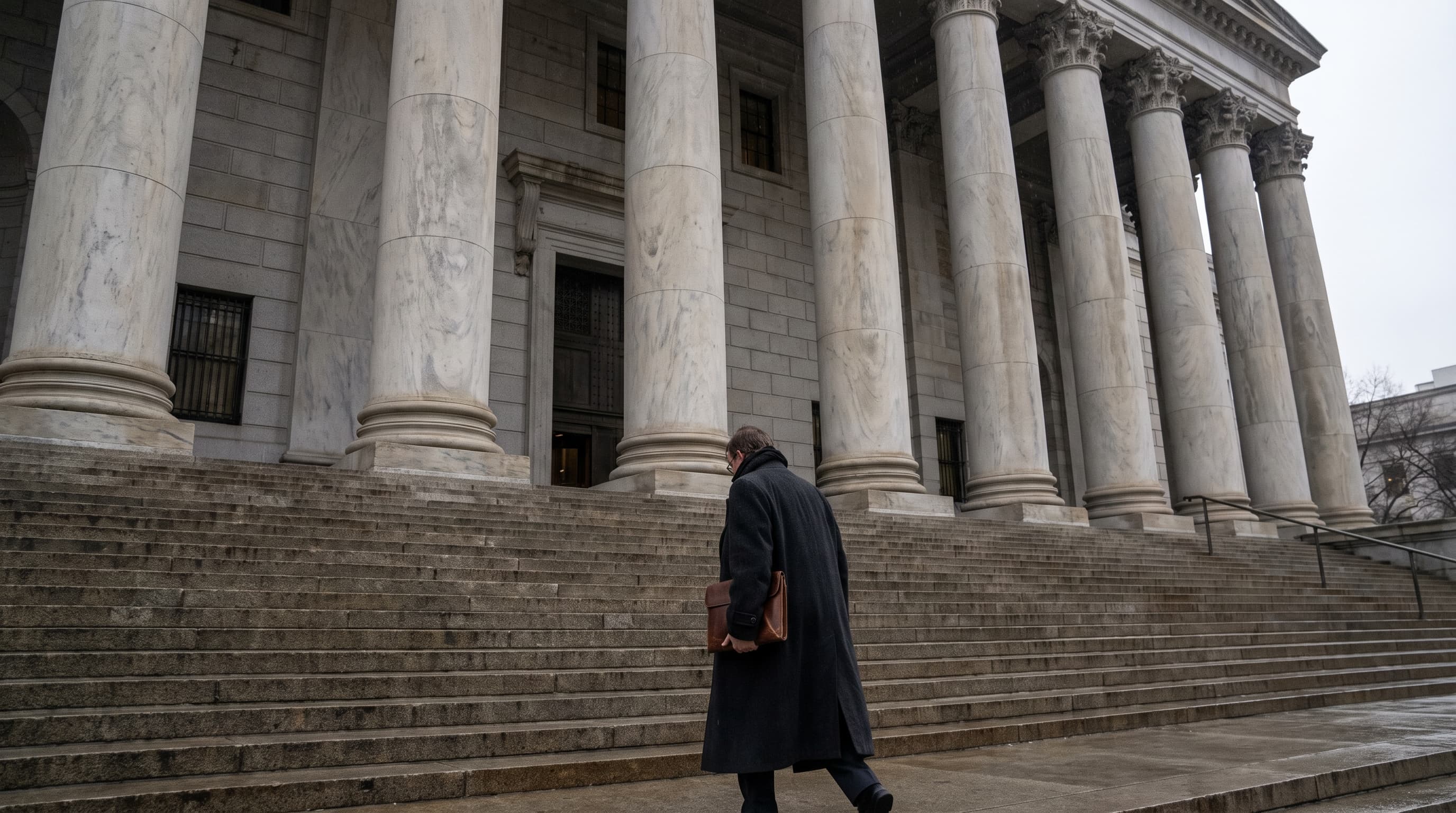
Supreme Court criminal cases 2026: The Supreme Court's 2026-27 term opens Monday, Oct. 5. Four criminal-law cases are on the fall calendar. If you are facing sentencing in federal court, earning First Step Act credits in federal prison, challenging a death sentence, or fighting to keep property the government wants to take, one of these cases could change your options.
Here is when each case is argued, what it asks, and who it affects.
The fall calendar
| Case | Docket No. | Argument | Issue | Who it affects | | --- | --- | --- | --- | --- | | Beaird v. United States | 25-5343 | Tues., Oct. 13, 2026 | Deference to Sentencing Guidelines commentary | Federal defendants at sentencing | | Maxwell v. Dinis | 25-5930 | Mon., Nov. 2, 2026 | Using habeas to enforce First Step Act time credits | Federal prisoners earning credits | | Guerrero v. Johnson | 25-1003 | Wed., Nov. 4, 2026 | Second federal habeas petitions and intellectual-disability claims | State prisoners, especially on death row | | Jouppi v. Alaska | 25-246 | Tues., Dec. 1, 2026 | Excessive fines and property forfeiture | Anyone facing civil or criminal forfeiture |
The term itself begins with a non-criminal case, Suncor Energy v. Commissioners of Boulder County, argued Oct. 5. The October sitting runs Oct. 5-14, according to SCOTUSblog.
Beaird v. United States: how much weight does Guidelines commentary get?
Argued: Tuesday, Oct. 13, 2026. From: the Fifth Circuit (No. 24-10764). Cert granted: April 20, 2026.

Federal judges calculate a sentencing range using the U.S. Sentencing Guidelines, written by the U.S. Sentencing Commission. The Commission also publishes commentary: notes that define terms and explain how the Guidelines apply. Under Stinson v. United States (1993), courts have given that commentary broad deference. In practice, a definition in the commentary can push your sentencing range up.
The Court agreed to decide, in the words of the Supreme Court docket, "Whether Stinson v. United States, 508 U. S. 36 (1993), still correctly states the rule for the deference that courts must give the commentary to the Sentencing Guidelines."
The facts
Kendrick Beaird pleaded guilty to being a felon in possession of a firearm. The Guidelines commentary defines a large capacity magazine as one accepting "more than 15 rounds of ammunition." Beaird's gun had a 17-round magazine. That triggered an enhancement under U.S.S.G. §2K2.1(a)(3), producing "a sentencing range of 63 to 78 months' imprisonment," according to ArentFox Schiff.
Beaird's brief, as quoted by Courthouse News, argues: "A 15-round magazine (and a 17-round magazine, at issue here) is a perfectly ordinary sized magazine in the contemporary consumer market."
The circuit split
Right now, where you are sentenced matters. Per ArentFox Schiff, "The Third, Sixth, DC, Ninth, and Eleventh Circuits apply Kisor's more rigorous framework before deferring to commentary," while "the First, Second, Fourth, Fifth, Seventh, Eighth, and Tenth Circuits continue to apply Stinson's broad deference."
On Oct. 1, 2026, the Court granted the Solicitor General's motion for divided argument.
Why it matters to defendants
ArentFox Schiff says a ruling against Stinson would give "federal judges more discretion to interpret the meaning of guidelines without required deference to the Commission, which could affect sentencing calculations across a wide range of offenses." Baker Donelson notes that white-collar Guidelines are especially sensitive to interpretive choices because they are "loss-driven and enhancement-heavy," and expects a decision by June 2027.
Procedural takeaway: If an enhancement in your case rests on a definition found only in the commentary, your lawyer can object at sentencing and preserve the issue while Beaird is pending.
Maxwell v. Dinis: what court do you go to when the BOP will not apply your credits?
Argued: Monday, Nov. 2, 2026. From: the Fifth Circuit, which ruled April 3, 2025. Cert granted: June 1, 2026.
How First Step Act credits work
Under 18 U.S.C. §3632(d)(4), a federal prisoner earns 10 days of time credits for every 30 days of successful participation in recidivism-reduction programming or productive activities. A minimum- or low-risk prisoner whose risk has not increased over two consecutive assessments earns an additional 5 days per 30 days. The credits "shall be applied toward time in prerelease custody or supervised release." The Bureau of Prisons FAQ says a prisoner can be moved to supervised release up to 12 months early. Prisoners convicted of disqualifying offenses are not eligible.
The case
William Maxwell "was convicted and sentenced to 20 years in federal prison for his role in a plan to take over a Texas mortgage company and loot it of its assets," SCOTUSblog reported. He filed a habeas application in 2022 over his time credits. The district court dismissed it because he had not fully exhausted administrative remedies. The Fifth Circuit "held that he should have brought a federal civil rights lawsuit instead."
The Court limited its review to one question: "whether an inmate's claim regarding the application of time credits, seeking accelerated transfer to a halfway house or home confinement under the First Step Act, can be brought as a petition for habeas relief" under 28 U.S.C. §2241.
The docket shows amicus briefs filed Aug. 12, 2026 by NACDL, FAMM, habeas scholars, Sen. Dick Durbin and Rep. Jamie Raskin. A court-appointed amicus filed a brief Sept. 18. In a Senate Judiciary Democrats' release, the senators say the Fifth Circuit judgment "threatens to undermine Congress's groundbreaking approach to prison reform." The senators' brief and release also cite a 9.7% rearrest rate among 44,671 people released under the law.
Procedural takeaway: This case decides which procedure a federal prisoner uses to challenge the BOP's handling of time credits. Maxwell's own petition was first dismissed for failure to exhaust, so working through the BOP's administrative process still matters while the Court decides.
Guerrero v. Johnson: when can a state prisoner file a second federal habeas petition?
Argued: Wednesday, Nov. 4, 2026. From: the Fifth Circuit (No. 23-70002). Cert granted: June 15, 2026.
The 1996 Antiterrorism and Effective Death Penalty Act (AEDPA) sharply limits second federal habeas petitions from state prisoners. One narrow exception covers claims that were "previously unavailable." SCOTUSblog frames the question as "Whether a death-row inmate's claim that he is intellectually disabled and therefore cannot be executed falls within one of the narrow exceptions in which a state prisoner can file a second petition for federal post-conviction relief."
The case
Dexter Johnson was convicted of capital murder in Texas in 2007 and sentenced to death, Bloomberg Law reported. He did not raise a claim under Atkins v. Virginia, which bars executing people with intellectual disabilities, in his original proceedings. The Fifth Circuit allowed a second petition because the claim became viable after "a 2013 update in how clinicians view IQ scores and disability."
Texas, through prison director Eric Guerrero, argues a claim is "previously unavailable" only if it could not have been raised earlier. Texas says the Fifth Circuit's ruling conflicts with the Fourth and Eleventh Circuits. On Sept. 24, 2026, the Solicitor General asked to take part in argument as amicus, per the docket.
Who it affects: State prisoners, especially on death row, whose claims rest on a legal rule that already existed but became viable only after changes in science or clinical standards.
Jouppi v. Alaska: can the state take a $95,000 plane over a six-pack?
Argued: Tuesday, Dec. 1, 2026. From: the Alaska Supreme Court. Cert granted: July 20, 2026.
Bush pilot Ken Jouppi was scheduled to fly a passenger from Fairbanks to Beaver, a dry village. Troopers found a six-pack of beer the passenger was bringing to her husband, SCOTUSblog reported. Jouppi was convicted of knowingly transporting alcohol to a dry village and received three days in jail and a $1,500 fine. The state then sought forfeiture of his $95,000 airplane. The Alaska Supreme Court held the forfeiture "is not grossly disproportional to the gravity of the offense for which he has been convicted."
The Eighth Amendment's Excessive Fines Clause limits what the government can take as punishment. The question, per the SCOTUSblog case page, is whether courts may weigh the gravity of the offense in the abstract or must examine "the gravity of the specific defendant's wrongdoing."
Who it affects: Anyone whose car, cash or other property is subject to forfeiture after a charge or conviction, including people facing theft, fraud, drug or DUI-related vehicle forfeiture.
What to do now
-
Raise and preserve the issue. If your case involves a commentary-based Guidelines enhancement, a dispute over First Step Act credits, a second habeas petition, or a forfeiture, ask your lawyer about objecting now so the argument is not lost.
-
Ask about timing. A pending Supreme Court case can affect when to proceed with sentencing, an appeal or a post-conviction filing. Your lawyer can advise whether to ask for a delay or press ahead.
-
Do not count on a date. Baker Donelson expects a Beaird decision by June 2027. The Court has not announced decision dates for Maxwell, Guerrero or Jouppi.
-
Follow the administrative steps. Federal prisoners disputing credits should keep using the BOP's administrative remedy process. Maxwell's petition was first dismissed for not exhausting it.
Other cases to watch
-
Kian v. Florida (25-6623): whether the Sixth Amendment requires 12-person juries. Argument not yet scheduled.
-
Viramontes v. Cook County (25-566): a challenge to an AR-15 ban, set for argument Dec. 2.
-
Nielsen v. Watanabe (25-417): whether to overrule Bivens, set for argument Nov. 9.
Related reading
-
Inside an Embezzlement Case, From the Employer's Audit to Restitution
-
How Families Can Challenge a Gang Label Before It Follows a Teen to Court
-
Is Your Old Shoplifting Record About to Be Sealed in Virginia?
Sources
-
SCOTUSblog: Court announces cases it will hear in October (Aug. 4, 2026)
-
SCOTUSblog: Court announces cases it will hear in November (Aug. 11, 2026)
-
SCOTUSblog: Criminal cases coming in the new term (Sept. 15, 2026)
-
SCOTUSblog: Justices grant new First Step Act case (June 1, 2026)
-
SCOTUSblog: Supreme Court agrees to hear airplane seizure case (July 20, 2026)
-
Courthouse News: Justices to reconsider power of federal sentencing advice (April 20, 2026)
-
Bloomberg Law: Justices Will Consider Dispute Over Successive Habeas Challenges (June 15, 2026)
-
Senate Judiciary Committee: Durbin, Booker Submit Amicus Brief in Maxwell v. Dinis (Aug. 12, 2026)
Note: This article contains AI-assisted content and has been reviewed by our editorial team.
IMPORTANT NOTICE: GavelDaily.com is an advertising and information service, not a law firm. Submitting this form does not create an attorney-client relationship. The information you provide will be shared with licensed criminal defense attorneys in your area who may contact you about your inquiry. All submissions are treated as confidential by our service, but attorney-client privilege does not attach until you formally retain an attorney. Any attorney you connect with through this service is independently responsible for their legal advice and representation. Free consultations are subject to individual attorney availability. If you are facing an immediate legal emergency, contact your local public defender's office or call 911.