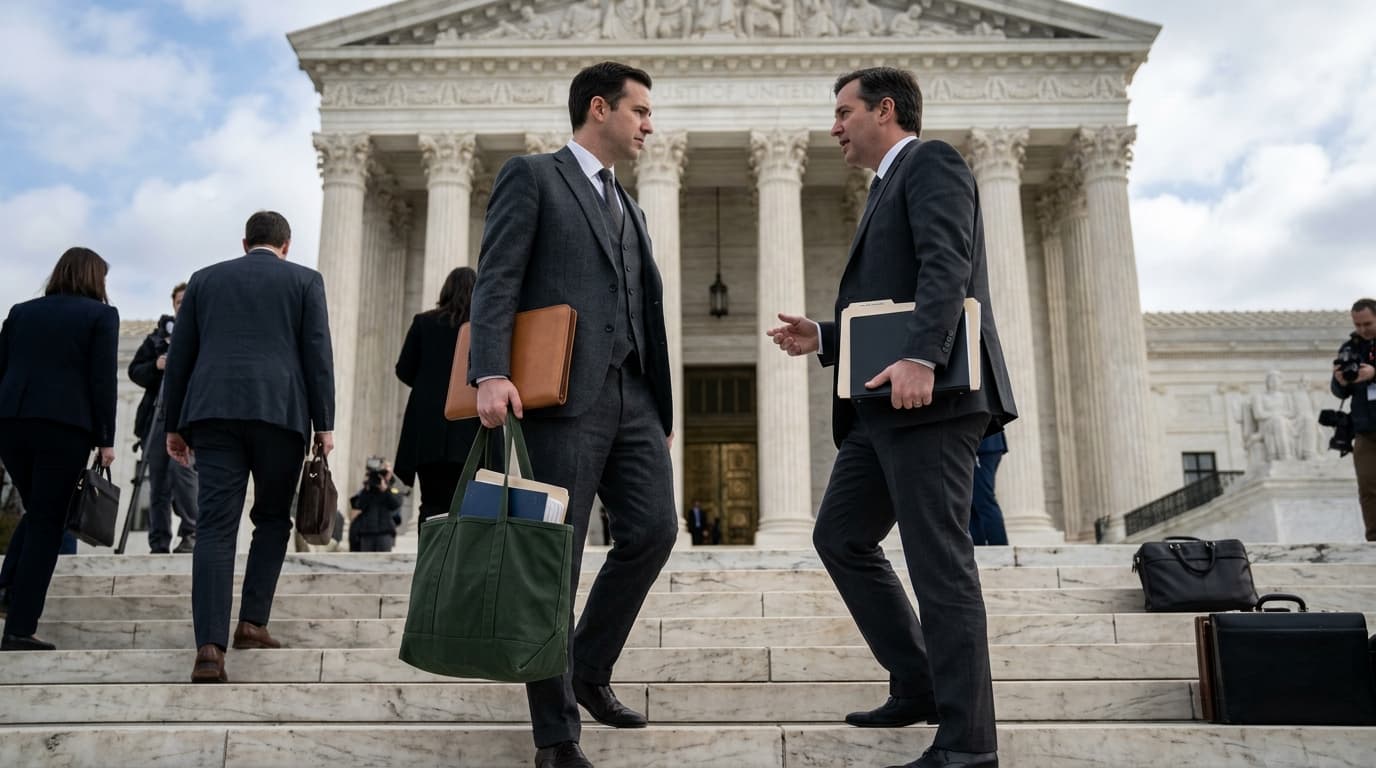
Ali Danial Hemani told FBI agents he used marijuana about every other day. That single admission, made after agents searching his Texas home found a Glock 9mm pistol, became a federal felony charge and is now the centerpiece of a Supreme Court case that could redraw the line on who the government may bar from owning a gun.
The case, United States v. Hemani, No. 24-1234, was argued on March 2, 2026. It asks whether 18 U.S.C. § 922(g)(3), the federal statute that prohibits firearm possession by "an unlawful user of or addicted to any controlled substance," violates the Second Amendment as applied to Hemani. After argument, a majority of the justices sounded openly skeptical that the law can be enforced against a casual or routine drug user without running into a constitutional wall. According to the SCOTUSblog argument recap, justices across the ideological spectrum pressed the government on how the statute defines a "user" and whether it punishes dangerousness or merely unlawful conduct.
What Section 922(g)(3) Actually Bans
Section 922(g)(3) makes it a federal crime for any person who "is an unlawful user of or addicted to any controlled substance" to possess a firearm. The reach is broad on its face. It does not require that a person be impaired while holding the gun, that the drug use be heavy, or even that the substance be illegal under state law. Federal law still classifies marijuana as a controlled substance, so a person who uses cannabis legally under state rules can still fall within the federal bar. The Cornell Legal Information Institute bulletin lays out the statute and the question presented in neutral terms.
The hard part is the phrase "unlawful user." The statute does not define how recent, how frequent, or how heavy the use must be to qualify. That ambiguity sat at the heart of the argument and is exactly what several justices seized on.
How the Case Reached the Supreme Court
The facts are narrow. The FBI executed a search warrant at Hemani's home in Texas and found a Glock 9mm and marijuana. Hemani admitted to agents that he used cannabis about every other day. That admission led to an indictment under § 922(g)(3).
Hemani won in the lower courts. Both the U.S. District Court for the Eastern District of Texas and the U.S. Court of Appeals for the Fifth Circuit ruled in his favor, finding the prosecution could not stand. The United States, as petitioner, asked the Supreme Court to reinstate the case. The government filed its cert petition on June 2, 2025, and the Court granted review on October 20, 2025, per the SCOTUSblog case file.
One feature of the case shapes everything about how a ruling might land: the challenge is as-applied, not facial. Hemani is not asking the Court to strike § 922(g)(3) for everyone. He argues only that it cannot constitutionally be applied to him on these facts. That posture points toward a narrow decision rather than a sweeping one.
The Bruen Test at the Center of the Case
The dispute turns on the framework from N.Y. State Rifle & Pistol Ass'n v. Bruen. Under that test, a modern gun restriction survives the Second Amendment only if the government can show it is consistent with the nation's historical tradition of firearm regulation. The question becomes whether there is a close enough historical analogue to disarming drug users.
The government's main analogues are historical laws disarming people who were considered dangerous or mentally ill, along with laws aimed at "habitual drunkards." Hemani's side argues that occasional or routine drug use is not a close match for those categories, and that the founding era did not strip gun rights from people simply because they used an intoxicating substance. The SCOTUSblog argument preview set out these competing historical arguments before the hearing.
Gorsuch Presses the Government to Define a 'User'
Justice Neil Gorsuch drove much of the skepticism. He pressed that the government "has not been able to define what a user is," and noted that even on Hemani's own facts, "we don't even know the quantity of how much he uses every other day."
Gorsuch then offered a hypothetical that captured the stakes for ordinary people in states with legal cannabis. He asked whether a Colorado resident who takes "one gummy bear every other night" from a state-licensed store to help sleep would count as a habitual user subject to the federal gun bar. Principal Deputy Solicitor General Sarah Harris answered, "Absolutely." That exchange, reported by the Washington Examiner, underscored how far the statute could reach if read literally.
Gorsuch also turned the government's "habitual drunkard" analogy against it by pointing to founding-era drinking habits. As detailed in Reason's argument analysis, he invoked John Adams's morning cider and James Madison's reported daily pint of whiskey to question whether the framers really understood regular drinking to forfeit the right to bear arms.
Skepticism Across the Ideological Spectrum
The doubts were not confined to one wing of the Court. Justice Amy Coney Barrett questioned whether the law targets dangerousness or mere unlawfulness, using the example of someone who takes a spouse's prescription Ambien. Justice Clarence Thomas asked about anabolic-steroid users, probing how far the "controlled substance" category stretches.
From the other direction, Justice Ketanji Brown Jackson voiced frustration that the Bruen framework blocks courts from crediting modern legislative judgments about which drug users are dangerous. As the firearms-policy outlet The Trace reported, the administrability problem cut in more than one direction, but the overall tone left the government on the defensive.
The Government's Defense
Sarah Harris defended the statute by emphasizing that prosecutors apply it case by case and that the law serves a real public-safety purpose in keeping firearms away from people whose drug use can impair judgment. The difficulty, repeatedly surfaced at argument, is line drawing. If the bar applies to a person taking a single nightly gummy as readily as to someone in the grip of addiction, the government struggles to explain where the constitutional limit sits and how a defendant could know in advance whether they qualify.
The Likely Outcome and Timing
The most probable result is a narrow, as-applied ruling rather than a wholesale invalidation of § 922(g)(3). Because Hemani challenged the law only as applied to his own conduct, the Court can rule for him without erasing the statute, leaving harder questions for future cases. Coverage from NBC News described the Court as leaning toward Hemani while keeping its options open on how broadly to rule.
A decision is expected by the close of the term, roughly June 2026. As of late May 2026, no opinion has issued.
Practical Stakes for Defendants
The outcome matters most for people charged with possessing a firearm while using a controlled substance, and especially for gun owners in states that have legalized cannabis. A ruling for Hemani would not automatically clear everyone charged under § 922(g)(3), but it could narrow when federal prosecutors can bring such charges against casual or state-legal users. If you are facing a charge that combines drug use and firearm possession, the specifics matter enormously: the substance involved, the frequency and recency of use, the state where you live, and whether the gun was connected to any other conduct. Those details can determine whether a prosecution survives, and they are best assessed by a defense attorney familiar with how courts in your jurisdiction are reading this fast-moving area of law.
Related reading
-
[Rahimi's Aftermath: Why Federal Domestic Violence Gun Prosecutions Are Splitting Circuits in 2026](/news/rahimi-aftermath-federal-domestic-violence-gun-prosecutions-circuits-2026)
-
After VanDerStok: How Ghost Gun Defenses Are Still Winning Motions in Federal Court
Sources
-
Supreme Court skeptical of law banning drug users from possessing firearms (SCOTUSblog argument recap)
-
United States v. Hemani (24-1234) (SCOTUSblog case file)
-
United States v. Ali Danial Hemani (Cornell Legal Information Institute Supreme Court Bulletin)
-
Gorsuch questions why marijuana gummy could strip someone's gun rights (Washington Examiner)
-
SCOTUS seems skeptical of the federal ban on gun possession by cannabis consumers (Reason)
-
Supreme Court leans toward a marijuana user's challenge to gun restriction (NBC News)
-
Supreme Court Questions Federal Gun Ban for Drug Users (The Trace)
-
Court to hear argument on whether and when drug users may possess firearms (SCOTUSblog argument preview)
Note: This article contains AI-assisted content and has been reviewed by our editorial team.
IMPORTANT NOTICE: GavelDaily.com is an advertising and information service, not a law firm. Submitting this form does not create an attorney-client relationship. The information you provide will be shared with licensed criminal defense attorneys in your area who may contact you about your inquiry. All submissions are treated as confidential by our service, but attorney-client privilege does not attach until you formally retain an attorney. Any attorney you connect with through this service is independently responsible for their legal advice and representation. Free consultations are subject to individual attorney availability. If you are facing an immediate legal emergency, contact your local public defender's office or call 911.